
“Stage 1”, “Stage 2” and “Stage 3” get used on forums as if they mean the same thing everywhere. They don’t. There’s no official standard, and one tuner’s Stage 2 is another’s Stage 1+. Here’s how we use the terms at Pulse Motorsport, what each one involves, and how to work out which one makes sense for your car.
| Stage 1 | Stage 2 | Stage 3 | |
|---|---|---|---|
| What changes | Software only | Software plus supporting hardware | Software plus major hardware |
| Typical parts | None: a standard car in good health | Intake, intercooler, exhaust, high-flow downpipe with a sports cat | Larger or hybrid turbo, fuelling, clutch, sometimes engine internals |
| Our price (inc. VAT) | £360 | £540 | Quoted per build |
| Reversible? | Yes: we keep your original file | Software yes; parts need refitting | It is a build, not a bolt-on |
| Best for | Daily drivers who want more response | Cars already running supporting mods | Track, drag and big-power builds |
A Stage 1 remap changes the software on your engine’s ECU and nothing else. Boost, fuelling, ignition timing and torque limits are adjusted within what the standard turbo, injectors and clutch can handle. On turbocharged petrol and diesel engines that’s usually the biggest gain per pound, because manufacturers leave headroom for poor fuel, hot climates and neglected servicing.
What you notice most is the mid-range: stronger pull from low revs, fewer downshifts on the motorway and easier overtakes. Naturally aspirated engines gain far less, and we’ll tell you if a remap isn’t worth it on your car.
Before we write anything, we check the car is healthy. Every remap at Pulse includes a fault-code health check, a baseline run on our Dyno Dynamics DS450 4WD dyno and a before-and-after graph to take home. We read and keep your original ECU file, so the car can be returned to standard. Stage 1 remap details and pricing.
A Stage 2 remap is written for a car with supporting parts fitted. The usual ones are a better intake, an uprated intercooler to keep intake temperatures down, a less restrictive exhaust and, on many turbo cars, a high-flow downpipe with a sports catalytic converter.
The parts on their own don’t do much; the map is what makes use of them. Fitting a downpipe and keeping a Stage 1 map leaves power on the table and can cause boost control faults. A Stage 2 map is calibrated for the parts that are actually on the car.
On a road car, keep the catalytic converter. Removing it is illegal on the road and will fail the MOT emissions test, which is exactly why sports cats exist.
On competition cars that are never used on public roads, we do recommend removing the cat as part of a Stage 2 or Stage 3 build, and the map is written to suit. That is for competition use only: a car without its cat is not legal on the road and will fail an MOT.
Stage 2 also loads the drivetrain harder. A clutch that coped at Stage 1 can start to slip, so it’s worth knowing its condition before you step up. Stage 2 remap details and pricing.
Stage 3 is where it stops being a remap and becomes a project: a larger or hybrid turbo, more fuel from uprated injectors and pump, and usually a clutch, cooling upgrades and sometimes engine internals to cope with the extra cylinder pressure. Every Stage 3 is different, so there’s no fixed price. We quote per car once we know the parts list and what you want from it.
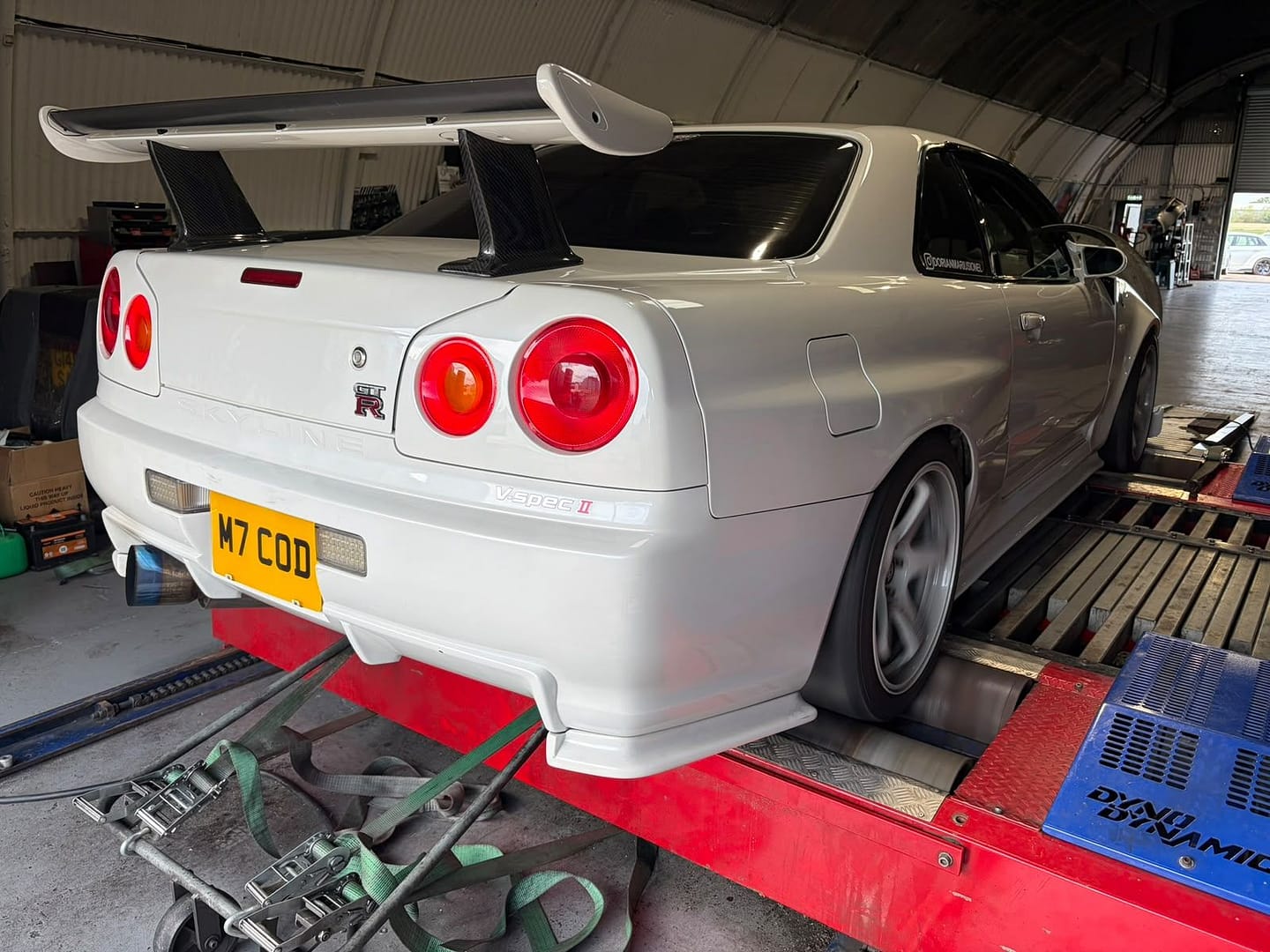
This is where a dyno earns its keep. A custom map on a big-turbo car is built run by run, watching air/fuel ratio, boost and timing under real load. Because ours is a 4WD dyno, four-wheel-drive cars such as a Golf R, Audi RS or GT-R can be mapped with the drivetrain working as normal. Stage 3 custom tuning.
They’re an option, not a stage, and can be added to most maps. Price on request: pops and bangs.
Our workshop is at Little Staughton, near Bedford: about 15 minutes from St Neots and around 25 minutes from Huntingdon and Bedford. We’re also under an hour from Milton Keynes and Luton.
Yes, if the supporting parts are already fitted and the car is healthy. The map is written for the parts on the car, not the label. If the parts are not fitted yet, start with Stage 1 and move to Stage 2 when they are.
The software is. We keep your original ECU file, so the car can be put back to standard. Hardware fitted for Stage 2 or Stage 3 would need refitting separately.
A remap is a modification, so you need to tell your insurer. Some charge more and some do not, and specialist modified-car insurers are often better value. Not declaring it can invalidate a claim.
Stage 1 is £360 and Stage 2 is £540, both including VAT. Stage 3 is quoted per car, because the parts and mapping time vary.
A sensible map on a healthy car, with the right supporting parts, stays within what the components can handle. Problems usually come from mapping a car with existing faults or pushing standard parts too far, which is why we check the car and take a baseline on the dyno first.
Tell us the car, what’s fitted and how you use it, and we’ll recommend a stage and give you a price. Call or WhatsApp 07460 752897, Monday to Friday 10am to 6pm and Saturday 10am to 4pm.


Unit 10, Airfield Industrial Estate, Little Staughton, Bedford MK44 2BN
Call or WhatsApp 07460 752897
[email protected]
Monday to Friday 10am to 6pm
Saturday 10am to 4pm
Copyright © 2026 Pulse Motorsport LTD | All rights reserved.